
Opinion The genteel communist
Jyoti Basu,the unquestioned patriarch of Bengal politics has passed away just at the moment where the edifice he so assiduously built is showing signs of crumbling.
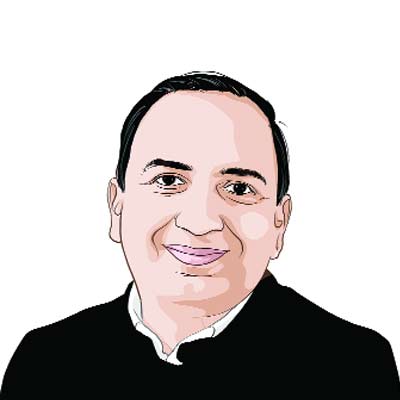



Jyoti Basu,the unquestioned patriarch of Bengal politics has passed away just at the moment where the edifice he so assiduously built is showing signs of crumbling. His legacy is so intimately tied to that political edifice that any assessment of his legacy depends upon an assessment of what 32 years of communist rule brought to West Bengal. It might seem a bit unfair to judge an unquestionably towering individual of exceptional stature by the fate of the political movement he bequeathed. But it is perhaps in the fitness of things. After all he remained,to the end,an individual whose allegiance and loyalty to his movement was both his greatest strength and weakness.
Jyoti Basu was chief minister for 23 years and exercised an unchallenged hold on the politics of West Bengal in a manner unprecedented in the annals of democratic politics. This is,in sheer political terms,a magnificent achievement. That this achievement was founded on Operation Barga,an effective consolidation of agrarian rights for sharecroppers,gave this achievement a great deal of social meaning. That Bengal remained politically stable,immune even from the politics of Mandal and Kamandal,is no small achievement.

In time Basu also managed two things that are the envy of every politician. He acquired a personal reputation that made him acceptable to large sections of the political class. This achievement made him contender for prime minister in 1996. His own party prevented him from accepting the prime ministership,in what he later termed a historic blunder. But that refusal added to his stature. He became a politician with an aura of personal effacement and sacrifice. He went from being powerful to being revered.
Some measure his achievement by describing him as a pragmatist. He was instrumental in the 60s,in making the Communist Partys peace with bourgeois democracy. An aura of revolution was the last thing his persona projected. His civility and sense of ease owed more to a bhadralok cultural sensibility than it did to a firebrand revolutionary. The Bengali upper classes made their peace with him because he became more a mascot of a genial Bengali identity. He seemed both a man of the movement and utterly non-threatening at the same time. He seemed also both worldly wise,and personally un-ambitious. He was a reminder to the world that whatever may have gone wrong with Bengal,it still retained something that politics elsewhere had lost: a sense that not everything is about pomp,show,power or crass instrumentalism. Only in Bengal could an ideology like communism not only find resonance with the upper classes,but also be mobilised in service of their cultural mores.
But this practical accommodation with bourgeois democracy and the projection of an austere civility cannot disguise the fact that he remained a committed communist,and in doing so cheated Bengal of true pragmatism. The two biggest symptoms of this are this. First,we cannot forget that Basu presided over a ruthless political party machine. Just like another great genial man of synthesis,Atal Bihari Vajpayee,built his power on the bedrock of a strong-fisted movement,Jyoti Babus graces could dance lightly on the surface,because he rested upon the iron grip of a party machine that was ruthless in its operations. In time that machine came to devour,in West Bengal,the very institutions of bourgeois democracy that he had so pragmatically accommodated himself to: the state.
Second,it is often said that Basu was a pragmatist in that he compromised with the broad structures of capitalism. This is true to a certain degree. West Bengal even took some small steps towards privatisation. But the truth remains that the party did all it could to scare away non-agricultural productive enterprise from Bengal. What Basu had in common with classic agrarian revolutionaries was a political hostility to urban development and life. Just at the time he was laying down the foundations of a possible agrarian prosperity,his government was quietly decimating the true comparative advantage that Bengal had: its intellectual base,and its deep history of capitalist enterprise. His pragmatism,if it was such,was pragmatism after the fact.
But perhaps more importantly,he and the movement he so ably led,was not pragmatic enough in one crucial respect. He did not use the power of the bourgeois state to prepare his core agrarian constituency for the challenges that lay ahead for them. It must have been obvious to anyone that Bengal would at some point require a transition from an agrarian society to a non-agrarian one,whatever its form. The ability of his constituents to participate in that transition would depend upon basic things like health and education. West Bengals unconscionable failure on this score,a failure whose roots go back to two decades of Basus rule is something of a puzzle. The only explanation is that while Basu accommodated himself to parliamentary politics,he remained indifferent to the potential of the bourgeois state to transform the lives of the constituents he so assiduously wanted to serve.
This is not to belittle his political achievement. Sometimes the true measure of a man is precisely the sense of regret over all that he could have achieved. Many analogies will be used to describe Jyoti Basu. But with the benefit of hindsight he reminds one more of tragic Rajput princes more than anyone else. These are people who built incredible political citadels,often at great personal sacrifice. They were even able to make them impregnable,and often worked with a sense that they were making history. The whirl of events,in the world at large,did not defeat them. But it did render them progressively more on the wrong side of history.
Basu built a magnificent political citadel against two enemies: the Congress centralism of Delhi and the horrendous exploitation of share croppers in Bengal. But while this was enough to keep his party secure in power,it was not enough to prepare his people for the whirlwind changes that India and the world have experienced. But it is a measure of his personal greatness that his contributions to Indian democracy will long survive debates over his ideological fidelity to communism. Some will regret that he was not more Maoist,more ruthless; others will regret that he was not Deng,more thoroughly pragmatist about development. But Indian democracy will be grateful that he remained Jyoti Basu: someone who knew how to consolidate real power,but who did not let it go to his head.
The writer is president,Centre for Policy Research,Delhi
express@expressindia.com
 Share
Share


