Journalism of Courage



 Located on the top of a plateau in Igatpuri taluka, Khairewadi is a tribal hamlet that houses nearly 40 families of the indigenous Ma-Thaker (Thakar) community, who are living here for several generations now. (Express Photo)
Balu Shid (29) and his wife Chhaya (28) from Nashik’s Khairewadi village have pledged to not cast their votes on May 20, along with 1,300 members from their community. Reason: Lack of drinking water.
Located on the top of a plateau in Igatpuri taluka, Khairewadi is a tribal hamlet that houses nearly 40 families of the indigenous Ma-Thaker (Thakar) community, who are living here for several generations now.
The villagers speak a Marathi dialect and predominantly work as farmers, while some work as caretakers and cleaners in nearby tourism resorts at Igatpuri.
In 2019, the villagers were promised water taps in every household under the Centre’s Jal Jeevan Mission (JJM) under which the Jal Shakti ministry aims to provide tap water to every rural household by 2024. However, five years since the promise of tap water, for Balu, Chhaya and several others it remains a pipe dream.
Alongside Khairewadi, tribal villagers from as many as 10 different hamlets in Igatpuri taluka have given a call to boycott the elections on May 20, as a sign of protest against lack of drinking water.
On May 9, The Indian Express visited two different villages in this district and found that in one village the contractors have done incomplete work, while in the other, actual civil work is yet to begin on the ground.
The villagers in the district are dependent on traditional “baudis” (groundwater well) for their daily water requirements and, in order to get to the nearest “baudi”, they walk 2-3 km up and down daily, trekking through the uneven terrain of the plateau.
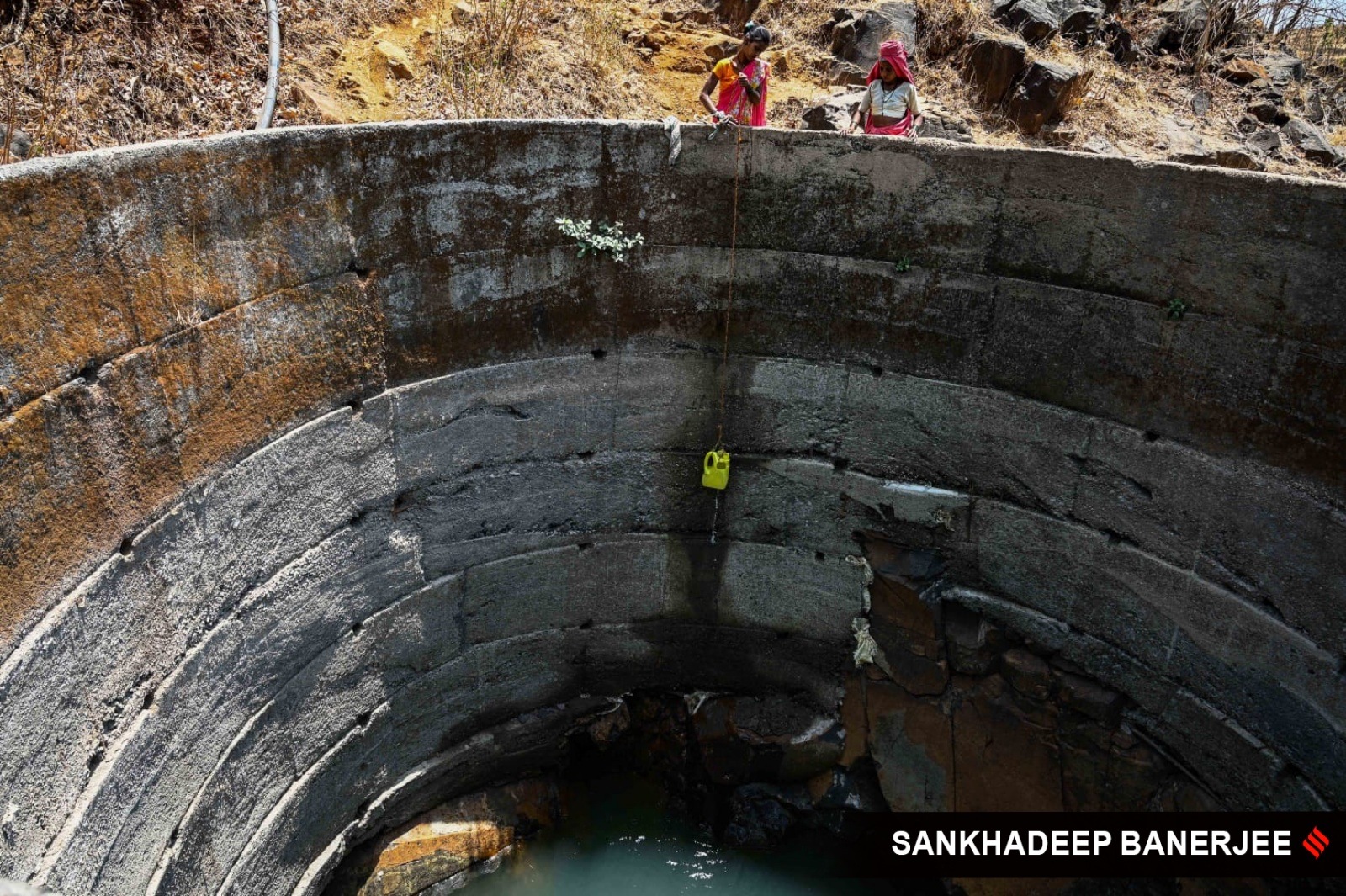 The villagers in the district are dependent on traditional “baudis” (groundwater well) for their daily water requirements. (Express Photo)
A traditional “baudi” is 20-25 feet deep and they get filled with water during the monsoon. Starting from March, every year, the water levels start to deplete and by April, the wells become entirely dried up. Following this, the villagers go to the Vaitarna river, 4 KM away from their villages to fetch water, till the wells get replenished during the rains.
“It has been 75 years since Independence, yet we have to struggle for basic amenities like water. For the past several years, we have only been given assurances that we will get water, but nobody kept their word. Therefore, we have decided to not vote henceforth, until we get regular water supply,” Balu said.
In Balu’s family there are five more eligible voters, including his three younger brothers, his father and his grandmother. The Shid family said not a single villager will cast their vote this time.
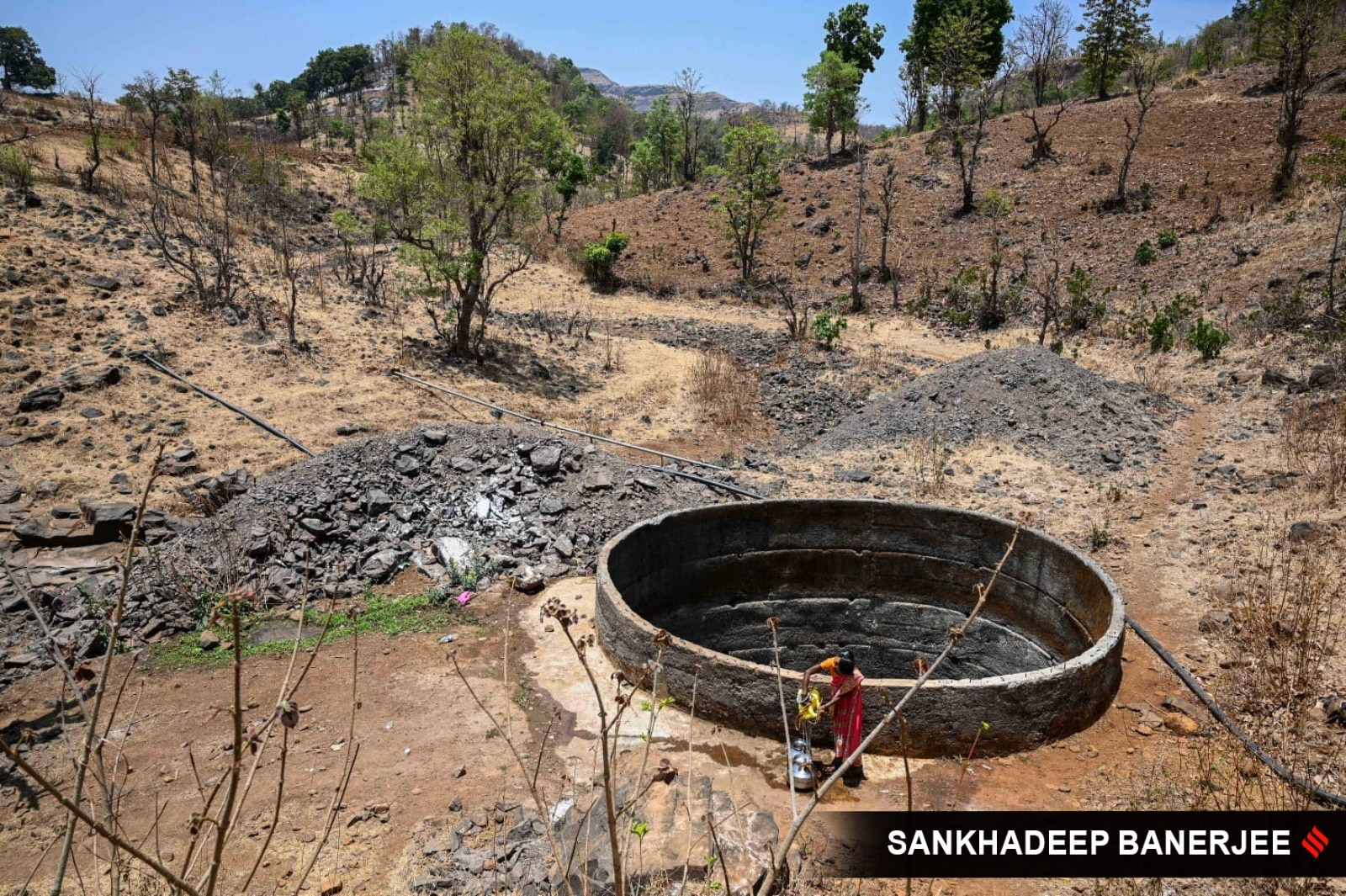 In order to get to the nearest “baudi”, villagers walk 2-3 km up and down daily, trekking through the uneven terrain of the plateau. (Express Photo)
At Khairewadi, the contractor appointed by local authorities have installed an elevated water reservoir of 10,000-litre capacity at an hill-top, which is the highest point of the village and have also constructed a meter room below. The idea was to draw groundwater into the reservoir through a pump and later disperse it to the households in Khairewadi and the neighboring hamlets of Babhalwadi and Vaitagawadi through pipes.
However, Express found that neither any pipeline has been laid, nor any pump has been installed inside the meter room. The wall of the foundation of the newly built tank has already developed cracks and the metal clamps were barely at their place. The villagers said both the tank and meter room were constructed in March 2023 and after that, the contractors didn’t show up to complete the work.
“We (villagers) have dug trenches and did all the masonry work when the tank was being built. The contractor had promised us a wage of Rs 25 for every one foot of work that we do. However, we are yet to receive that money as well,” said a villager.
 In 2019, the villagers were promised water taps in every household under the Centre’s Jal Jeevan Mission (JJM) under which the Jal Shakti ministry aims to provide tap water to every rural household by 2024. (Express Photo)
Shiv Sena’s Hemant Godse is a two-time sitting MP from Nashik constituency, who is fighting to retain the seat this year. The villagers said traditionally they have voted for the Congress and undivided Sena; however, they don’t have any political allegiance to any party.
“Since there is no road connecting our village, the candidates don’t come here to ask for votes. The nearest polling booth is 3 km away from our village and we walk to the booth to cast our votes,” Balu said.
The women in the villages make at least 3-4 trips daily to the “baudis” to fetch water, starting as early as 5 am. Chhaya said they have to start early to be able to complete the first two trips before the day becomes too hot.
 At Khairewadi, the contractor appointed by local authorities have installed an elevated water reservoir of 10,000-litre capacity at an hill-top, which is the highest point of the village and have also constructed a meter room below. (Express Photo)
There is only one “baudi” in Khairewadi, which also caters to the neighboring hamlets of Babhalwadi and Vaitagawadi. “Between March and May, the “baudis” become empty and we have to go to the Vaitarna river to fetch water, which is 4 km away. Even fetching water from the well is very tedious, as there is no road and walking through on uneven surfaces causes blisters in our feet. We also faint sometimes,” said Chhaya.
Sakri Bai (80), who has been staying in the village for more than six decades now, said by drinking water from these wells the villagers often fall sick. “The wells are not covered and the water inside gets contaminated easily. As a result, many villagers especially the elderly and children fall sick regularly,” she said.
“It feels our village is stuck at the same place it was when I was young. Most houses here don’t have toilets and everybody, including the women, go to the field,” said Dhalurao Shende (65), another villager.
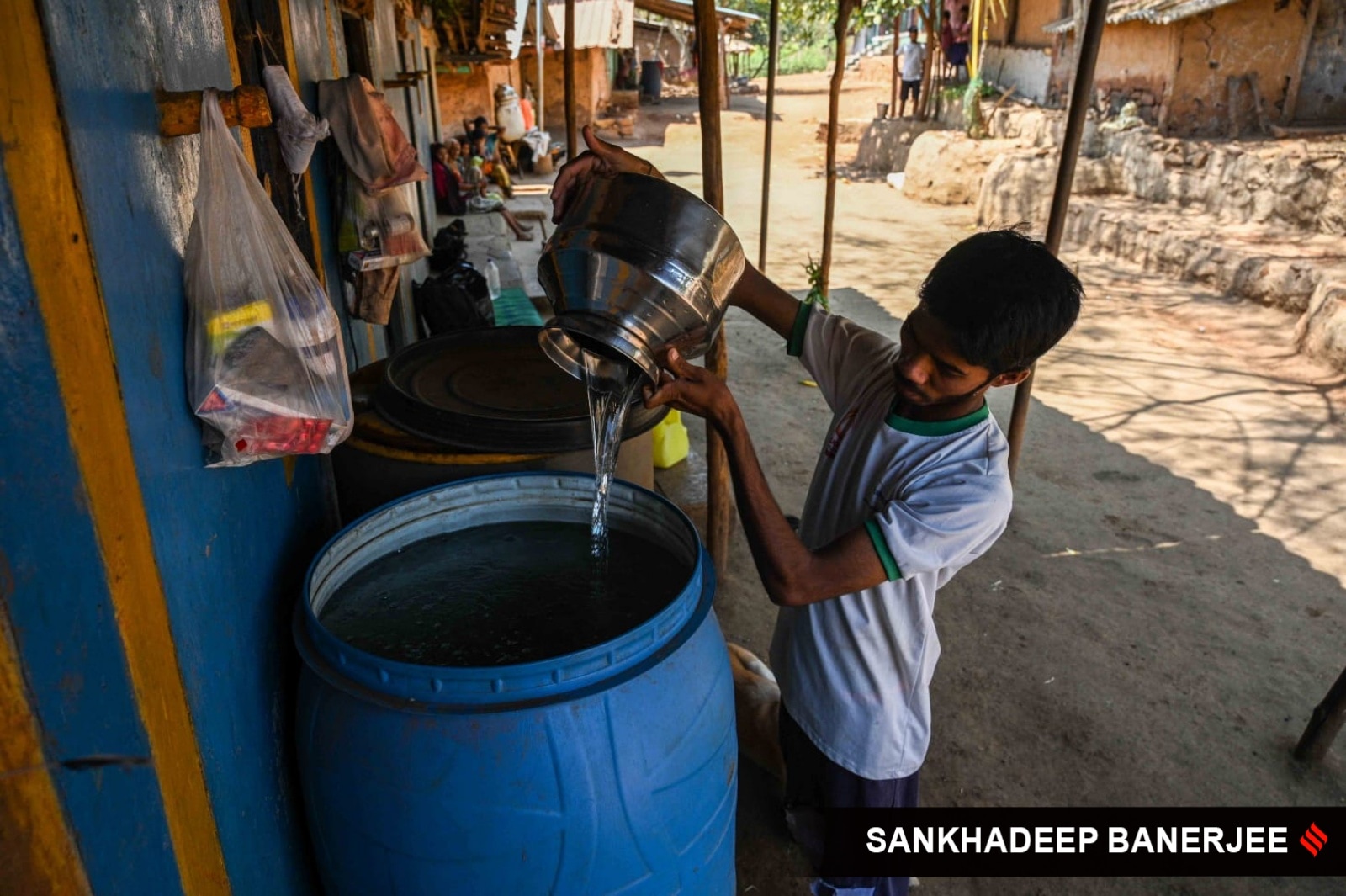 Alongside Khairewadi, tribal villagers from as many as 10 different hamlets in Igatpuri taluka have given a call to boycott the elections on May 20, as a sign of protest against lack of drinking water. (Express Photo)
The villagers say electricity came in 2019 and, before that, they used earthen lamps.
Speaking to Express, Mangesh Khadake (68), sarpanch of Chinchalekhaire panchayat, under whose jurisdiction Khairewadi, Babhalwadi and Vaitagwadi fall along with two other villages, said, “The work of JJM in our village started only last year and the contractors have been doing the work at a very slow pace. The workers haven’t shown up in several months and we have raised this issue multiple times with the collector’s and tehsildar’s office but no action has been taken yet.”
With a population of over 1,400 villagers, there are more than 200 households that come under this panchayat. Khadake said all villagers, including himself, have pledged to boycott the elections this year.
Thirty km away from Khairewadi is Marutiwadi village that falls under the panchayat of Kurungwadi. Situated in one of the valleys of the Deccan plateau, Marutiwadi houses 35 tribal families and has a total population of 350.
Unlike Khairewadi, in Marutiwadi the actual work for JJM is yet to begin on ground, and the villagers said that not a single person will cast vote on May 20.
“Last time, we were promised water connection under JJM and we had submitted all our documents but not a single household from our village have received a water connection, the roads are so bad that even water tankers can’t reach us and the only source of water we have is the “baudis”, whose water levels are also depleting fast,” said Babuchander Sawant (45), a fourth-generation villager.
Another villager, Shanta Bai (61), said the nearest “baudi” is 2 km away. “The ‘baudi’ is 2 km uphill and at times we have to stand in a queue from 6 am. Due to excessive heat this year, the water level in the ‘baudis’ have started to deplete and if the monsoon is delayed then we will have to live without water,” she said.
Almost every household earns their living by farming and cattle rearing. Shanta Bai said due to scarcity of water, many villagers have sold their cattle. “A cow or an ox requires 3-4 tumblers of water daily, we have two oxen and during summer stocking such a heavy volume of water becomes difficult for the villagers. But we don’t have any option as we are dependent on these animals for manure and other necessities,” she said.
According to the ministry’s JJM dashboard, Maharashtra has drawn Rs 7,444 crore for this mission, which is the second highest after Uttar Pradesh, which has drawn Rs 16,947 crore so far. The dashboard further shows that till date 17,143 villages in Maharashtra have received 100% tap connection. The dashboard also showed that status of work in the villages under Chinchalekhaire and Kurungwadi panchayats is currently ‘in progress’.
Tribal community leader Bhagwan Madhe told Express that villagers in more than 50 villages across Igatpuri and Trimbakeshwar in Nashik district have called for boycotting the elections due to lack of water supply. “If the contractors did their work properly, then almost all the villages in this district would have got water supply by now. The point is, most of the contractors have done incomplete work or have done nothing at all, but on paper it shows actual work is ‘in-progress’. There are so many villages where tanks have been fitted one-two years back, but water isn’t there,” Madhe said.
After receiving multiple complaints from villagers, the executive engineer of the rural water supply department had written to the deputy engineer on April 13, asking the latter to carry out an investigation. However, officials from local zilla parishad’s office said that no inquiry or investigation have been initiated yet.
Meanwhile, when The Indian Express contacted the authorities, Sudhir Khande, sub-divisional officer (SDO), Igatpuri, said, “The balance work in all the villages will begin in a week and we will follow up with all the complaints and the delay of work will be investigated.”
When contacted, one of the contractors of Chinchalekhaire (Igatpuri) told The Indian Express, “The work order for acquiring tanks was issued only after 2022. Therefore, it took some time for us to start work. Also, most of these villages are in rocky terrain and it’s difficult to reach there. We have limited manpower so adhering to the deadline is not possible every time.”
Another official, who is involved with the JJM project in Igatpuri, said on the condition of anonymity, “We admit, the pace of work in Igatpuri has been slow, but the reasons were absolutely valid. In a village like Khairewadi, the contractors and workers hesitate to go as there is no road and one has to trek through the terrain for up to 3 km.” “Also, in many villages, land acquisition is a big issue as the land that are owned by panchayats aren’t feasible for setting up a tank, therefore we have to acquire land separately from villagers and this process is also time consuming,” the official added.

 11 min read