Journalism of Courage



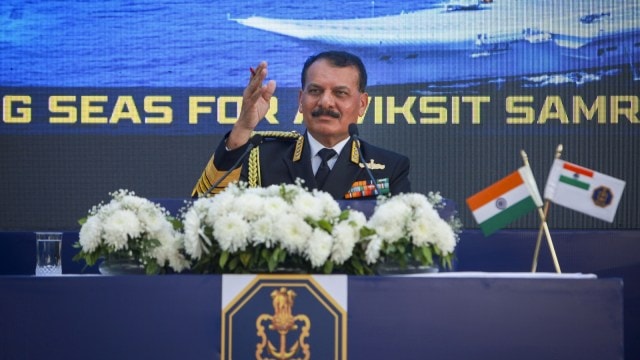 Navy Chief Admiral Dinesh K Tripathi in New Delhi. (PTI)
India will commission its third nuclear submarine soon as it is in the final stages of trials, Chief of Naval Staff Admiral Dinesh Tripathi said Tuesday.
The induction of INS Aridhaman will take India’s operational fleet of the Arihant-class nuclear-powered ballistic missile submarines (SSBN) to three, marking a significant step in strengthening the country’s sea-based nuclear deterrent.
“(INS) Arighaat was commissioned in August 2024 and Aridhaman will be commissioned soon. It is in the final stages of trials,” Admiral Tripathi told the press ahead of Navy Day on Thursday.
Expected to be commissioned around 2026-27, Aridhaman is designed to carry the longer-range K-4 submarine-launched ballistic missiles and will move India closer to sustained, near-continuous at-sea nuclear deterrent patrols, a key requirement of a credible second-strike capability.
China operates around six Jin-class SSBNs with the long-range JL-series missiles and conducts near-continuous nuclear patrols.
Apart from the SSBNs, India is also pursuing a nuclear-powered attack submarine (SSN) programme. The Navy plans to build two SSNs indigenously and acquire one on lease from Russia, which is expected to bridge the capability gap until India’s own boats are ready.
“Large navies do carry SSNs. Last time the government had given approval to construct two SSNs indigenously. We are proceeding as per plan one year down the line. SSNs can’t be constructed overnight. We are doing it for the first time. So it will happen sometime in the middle of the next decade. Meanwhile, we are likely to get one SSN from our friendly foreign partner and that will fill the gap till the time we have our own SSN,” Admiral Tripathi said.
A senior Navy officer said the Russian SSN is likely to be delivered in 2027-28. “We are pushing for 2027, but it may come by 2028,” the officer said.
The Navy chief also made a strong case for a third aircraft carrier, while acknowledging that for a period India would continue to operate only two as a new induction would coincide with the retirement of an older carrier.
“We absolutely need another aircraft carrier. Our concept of war at sea is based on carrier battle groups,” he said. “It is an integrated carrier battle group where the carrier provides requisite defence to the ships which are there to carry out various specific tasks for the force. We also need escorts to support the carrier.”
India currently has two aircraft carriers: INS Vikramaditya, commissioned in 2013, and INS Vikrant, commissioned in 2022. “By the time our (third) aircraft carrier comes, we believe that the INS Vikramaditya will be at the end of its life. Therefore, in effect, we will end up with two aircraft carriers,” he said, reiterating that the Navy’s long-standing goal remained a three-carrier force – one each on the eastern and western seaboards and one for exigencies.
Responding to questions on the challenge from China, the Navy chief said, “The PLA Navy poses a challenge (in the Indo-Pacific). But we don’t look at country-specific threats, we look at our national maritime interests and what it entails at the force level to safeguard our interests. In that the aircraft carrier is one piece.”
He said while the Indian Ocean Region remained the Navy’s primary focus, India’s interests extended across the Indo-Pacific. “One of our ships was in Guam, one was exercising with the Hellenic Navy in the Mediterranean, one was in Mauritius, another in Fiji… so wherever our national maritime interest takes us, we will go.”
On whether deployment in the South China Sea was increasing, Admiral Tripathi said Indian warships transited the region routinely as part of bilateral and multilateral engagements with countries such as Vietnam, the Philippines, Japan and South Korea. “It is not a specific deployment for the South China Sea, it is part of our larger deployment plan,” he said.
He also spoke about the Navy’s role during Operation Sindoor. He said the aggressive posturing and immediate deployment of the carrier battle group in the Arabian Sea forced the Pakistan Navy to remain confined to its ports. “There was complete synergy between the three forces,” he said.
This, he said, also had an economic impact on Pakistan. “Many of the major shipping companies of the world started avoiding Pakistani ports. There was an increase in the insurance premiums if you were going to Pakistan ports. For the last few months, we have continued to maintain a high tempo of operations, including in the Arabian Sea,” he said.
On the issue of women submariners, he said the Navy was working towards their induction into the submarine arm. “It is the last bastion because of space constraints. It is a question of time. Many navies have women submariners. We believe in a gender-neutral force and we are using gender-neutral language,” he said.



 5 min read